
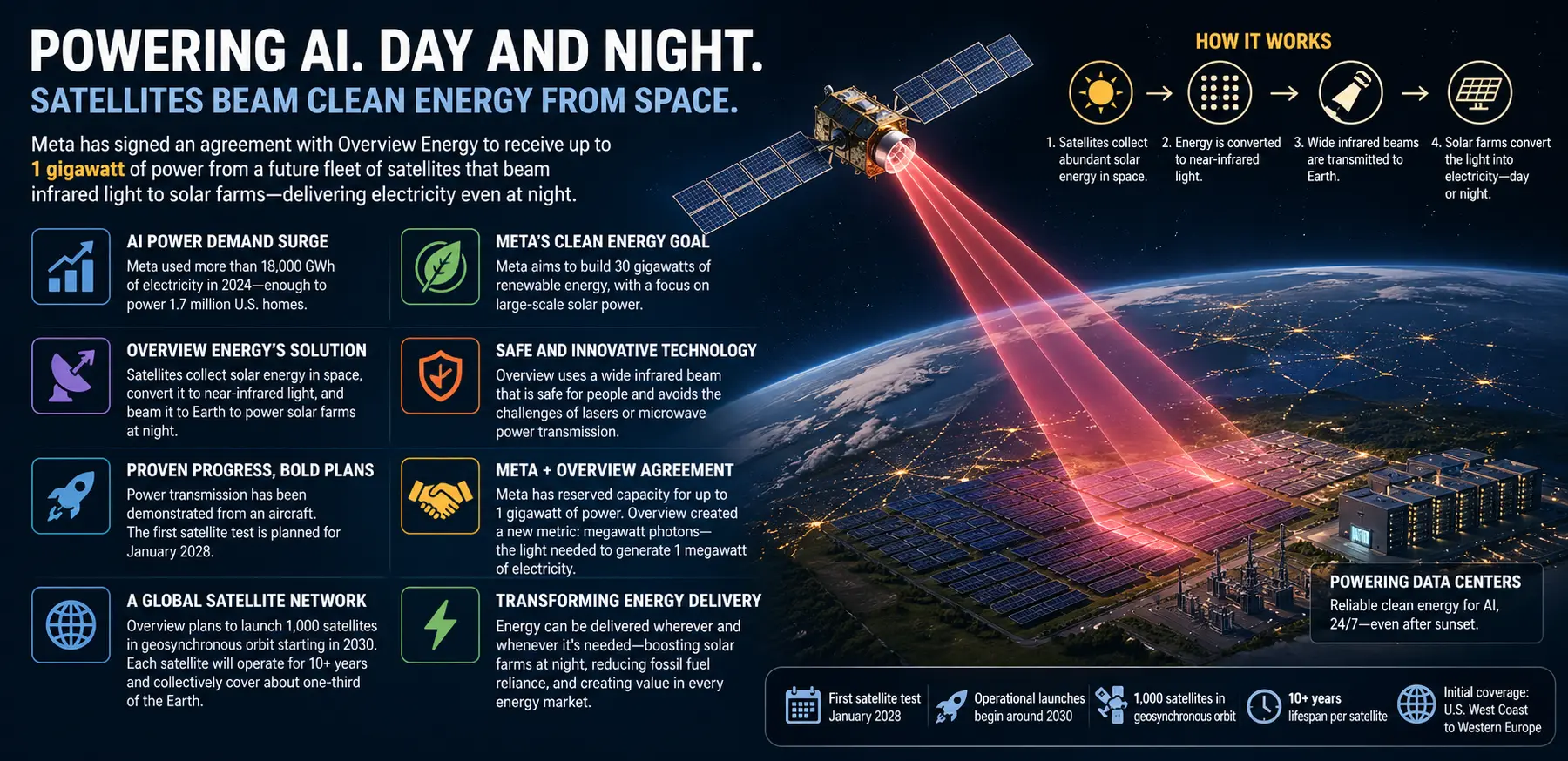
The demand for electricity to run advanced AI models is growing rapidly, pushing tech companies to explore new energy solutions. Meta alone consumed over 18,000 gigawatt-hours of electricity in 2024—enough to power around 1.7 million U.S. homes annually—and its energy needs continue to climb.
For more articles
Meta’s Renewable Energy Strategy
To meet this rising demand, Meta has committed to developing 30 gigawatts of renewable energy, with a strong focus on large-scale solar farms. However, solar power has a major limitation: it doesn’t generate electricity at night, forcing data centers to rely on battery storage or alternative energy sources.
Overview Energy’s Space-Based Solution
Overview Energy, a startup based in Ashburn, Virginia, is proposing a different approach. The company is developing satellites that collect solar energy in space and convert it into near-infrared light. This light would then be transmitted to large solar farms on Earth, which can convert it back into usable electricity—even during nighttime.
How the Technology Works
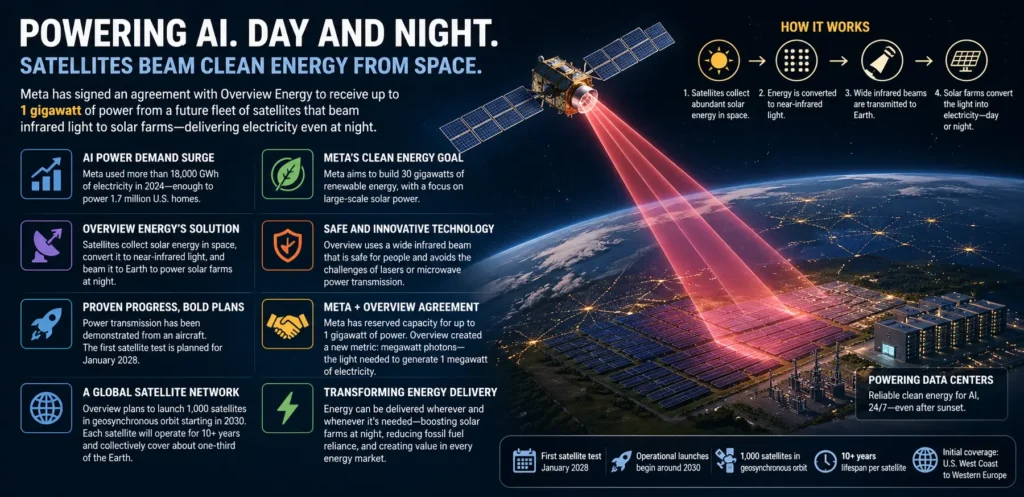
Instead of using high-powered lasers or microwave beams, Overview plans to use a wide infrared beam. This approach is designed to avoid many of the safety and regulatory challenges associated with traditional space-based power transmission. According to CEO Marc Berte, the beam would be safe enough for humans to look at without harm.
Early Progress and Future Plans
Overview has already demonstrated the ability to transmit power from an aircraft to the ground. The company aims to launch its first satellite into low Earth orbit in January 2028 to test space-based power transmission.
Meta’s Agreement with Overview
Meta has signed a capacity reservation agreement with Overview to receive up to 1 gigawatt of power from its future satellite network. The deal introduces a new measurement unit called “megawatt photons,” representing the amount of light needed to generate one megawatt of electricity.
Satellite Network Vision
Overview plans to begin launching operational satellites around 2030, with a long-term goal of deploying 1,000 spacecraft in geosynchronous orbit. Each satellite is expected to operate for more than a decade and collectively cover about one-third of the Earth, initially spanning from the U.S. West Coast to Western Europe.
Transforming Global Energy Delivery
As the Earth rotates and solar farms move into darkness, these satellites would continue supplying energy from space. This approach could significantly increase the efficiency of solar infrastructure, reduce dependence on fossil fuels, and create a flexible, global energy delivery system.
