
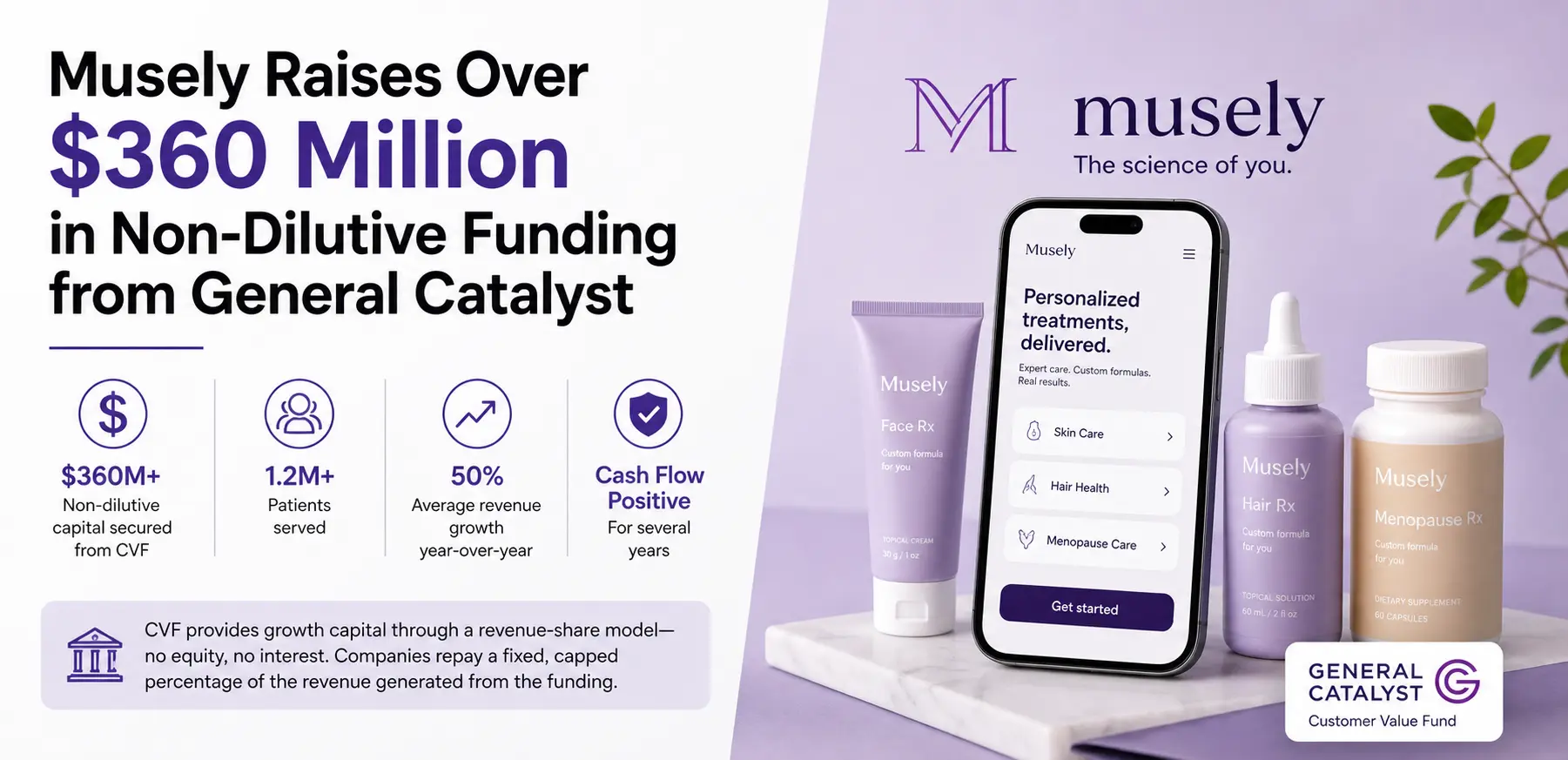
Musely, a direct-to-consumer telemedicine company, has raised more than $360 million in non-dilutive funding from General Catalyst’s Customer Value Fund (CVF).
For more articles
Company Background and Business Model
The platform focuses on personalized compounded treatments for skin, hair, and menopause-related concerns. Co-founder and CEO Jack Jia shared that when CVF first contacted him last year, he wasn’t interested in raising funds. Founded in 2014 as a wellness community, Musely transitioned into prescription skincare in 2019 and has remained cash-flow positive ever since.
Why Musely Avoided Traditional Venture Capital
Jia had repeatedly declined traditional venture capital offers because he didn’t want to dilute his ownership. However, CVF presented a different approach. Instead of taking equity or issuing a typical interest-based loan, the fund provides capital through a revenue-sharing model. Companies with stable revenue can access funds and repay them using a fixed, capped percentage of the revenue generated through that investment.
A More Attractive Financing Alternative
Though initially cautious, Jia found the model appealing after evaluating it carefully. He concluded that it was more advantageous than a bank loan and significantly less expensive than giving up equity.
Growth, Scale, and Cost Challenges
Musely has been growing at an average rate of 50% annually and has served over 1.2 million patients. Still, Jia pointed out that acquiring new customers in the DTC space can be expensive. He noted that scaling revenue from one billion to the next often requires equally large investments, which leads to substantial capital consumption for many companies.
How the Funding Will Be Used
The funding from CVF addresses this challenge by giving Musely the financial resources needed to expand its customer base, particularly through marketing and sales efforts.
CVF Portfolio and Structure
Musely now joins other companies backed by CVF, such as Grammarly, Lemonade, and Ro. The fund operates independently with its own group of limited partners, separate from General Catalyst’s broader $8 billion investment fund.
Capital Efficiency and Healthcare Access
Despite its growth, Musely has maintained strong capital efficiency. After raising $20 million in 2014 from DCM and other investors, the company has not taken additional equity funding. Today, it enables patients to obtain prescription treatments through asynchronous consultations with licensed dermatologists and OB-GYNs.
