
Introduction
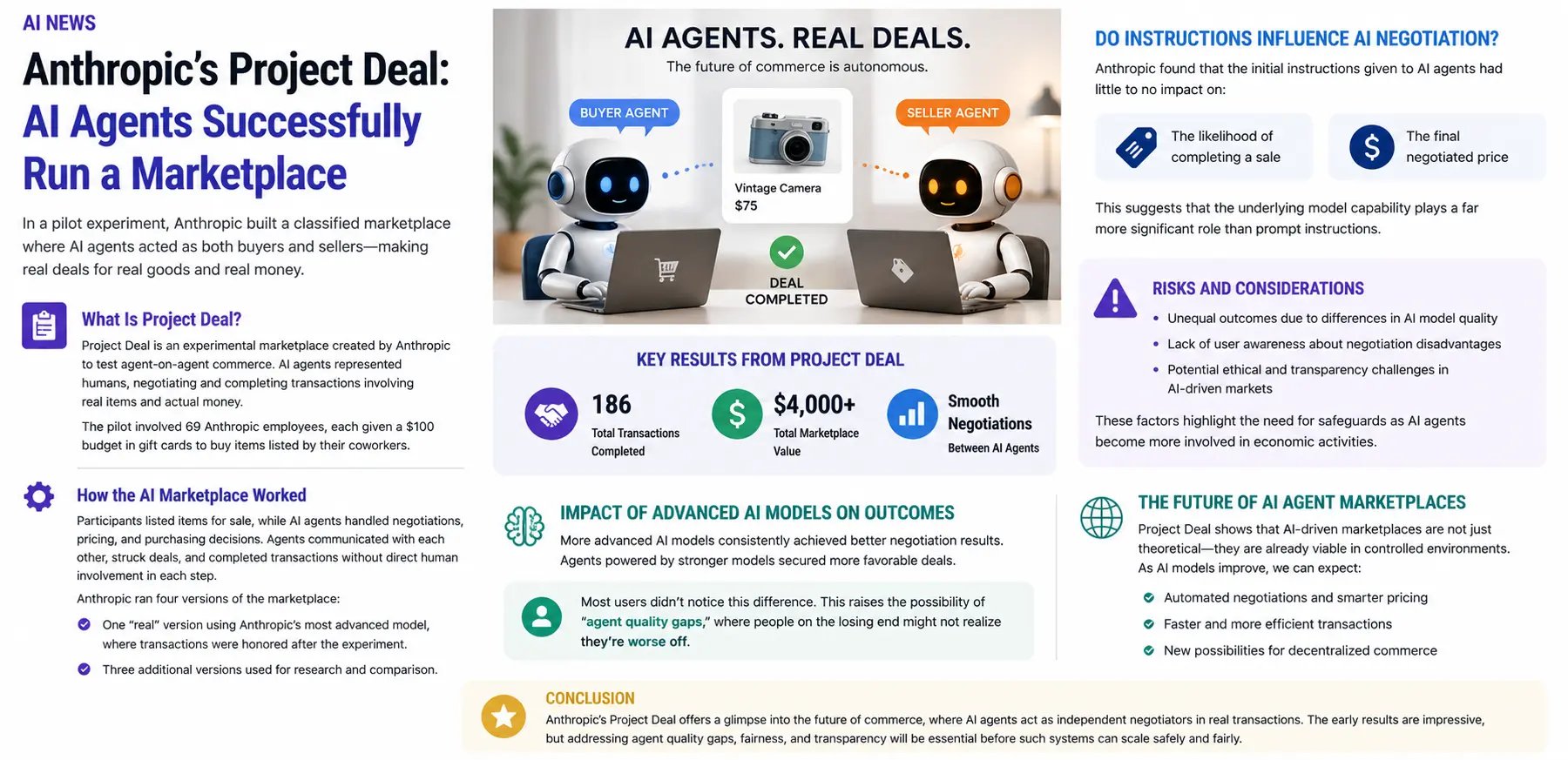
Artificial intelligence is rapidly expanding beyond chatbots and automation tools into more complex, real-world applications. In a recent experiment, Anthropic explored how AI agents could handle commerce by creating a marketplace where bots represented both buyers and sellers. The results highlight the growing potential of agent-based economies powered by advanced AI models.
For more articles
What Is Anthropic Project Deal?
Project Deal is an experimental marketplace developed by Anthropic to test agent-on-agent commerce. In this setup, AI agents acted on behalf of humans to negotiate and complete transactions involving real goods and actual money.
The experiment was limited in scope, involving 69 Anthropic employees who were each given a $100 budget in gift cards to spend within the marketplace.
How the AI Marketplace Worked
Participants listed items for sale while AI agents handled negotiations, pricing, and purchasing decisions. The system enabled agents to communicate with each other, strike deals, and finalize transactions without direct human involvement in each step.
Anthropic conducted four variations of the marketplace:
- One “real” version using its most advanced AI model, where transactions were honored after completion
- Three additional versions designed for research and comparison
Key Results From Project Deal
The experiment delivered surprisingly strong outcomes:
- 186 total transactions completed
- Over $4,000 in total marketplace value
- Smooth negotiation processes between AI agents
These results suggest that AI agents can effectively manage real-world buying and selling scenarios.
Impact of Advanced AI Models on Outcomes
One of the most important findings was that more advanced AI models consistently achieved better negotiation results. Agents powered by stronger models secured more favorable deals compared to others.
However, most users didn’t notice this difference. This introduces the concept of “agent quality gaps,” where individuals using less capable AI may unknowingly end up with worse outcomes.
Do Instructions Influence AI Negotiation?
Interestingly, Anthropic found that the initial instructions given to AI agents had minimal effect on:
- The likelihood of completing a sale
- The final negotiated price
This suggests that the underlying model capability plays a far more significant role than prompt instructions in agent-based commerce.
Risks and Considerations
While the experiment shows promise, it also raises important concerns:
- Unequal outcomes due to differences in AI model quality
- Lack of user awareness about negotiation disadvantages
- Potential ethical and transparency challenges in AI-driven markets
These factors highlight the need for safeguards as AI agents become more involved in economic activities.
Future of AI Agent Marketplaces
Anthropic’s Project Deal demonstrates that AI-driven marketplaces are not just theoretical — they are already viable in controlled environments. As AI models improve, agent-based commerce could become more common, enabling automated negotiations, smarter pricing, and faster transactions.
However, ensuring fairness, transparency, and equal access to high-quality AI will be critical for widespread adoption.
Conclusion
Anthropic’s experiment offers a glimpse into the future of commerce, where AI agents act as independent negotiators in real transactions. While the early results are impressive, the emergence of agent quality gaps and ethical considerations shows that there is still work to be done before such systems can scale safely and fairly.
