
Major tech companies like Microsoft and Meta are increasingly investing in natural gas to power their expanding data centers. The surge in AI-driven computing demand has pushed firms to secure reliable energy sources, making fossil fuel-based power plants an attractive option despite environmental concerns.
For more articles
Rising Costs of Gas Power Plants
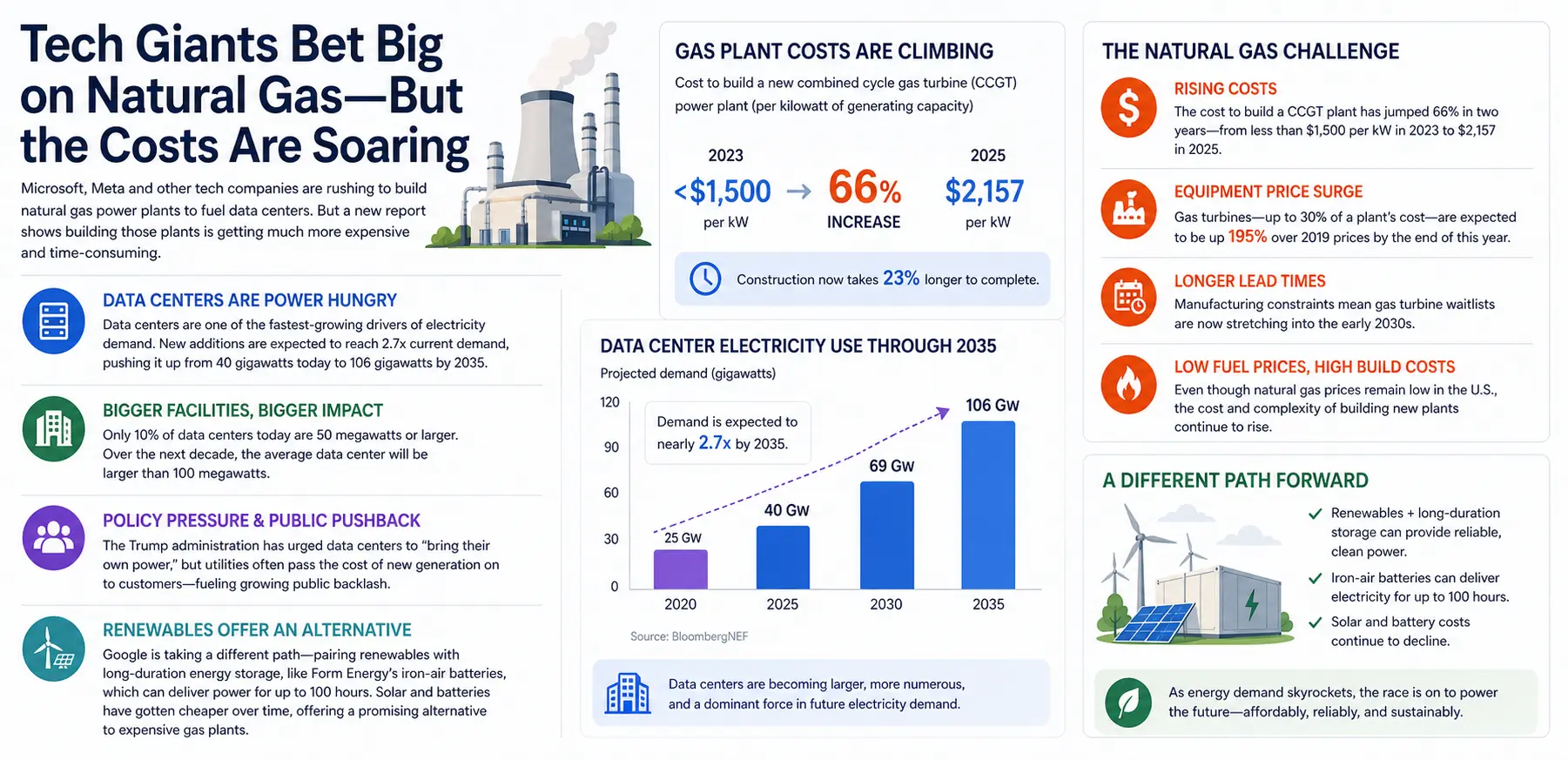
Building natural gas power plants has become significantly more expensive. According to BloombergNEF, the cost of constructing a combined cycle gas turbine (CCGT) plant has jumped 66% in just two years — rising from under $1,500 per kilowatt in 2023 to $2,157 in 2025. In addition, construction timelines have stretched by 23%, further complicating expansion plans.
Data Centers Driving Energy Demand
Data centers are among the fastest-growing sources of electricity consumption. Current demand stands at around 40 gigawatts, but projections suggest it could reach 106 gigawatts by 2035 — nearly 2.7 times higher. Facilities are also getting larger, with future data centers expected to exceed 100 megawatts on average, compared to just 10% reaching 50 megawatts today.
Policy Pressure and Public Backlash
Government policies have added complexity to the situation. Data center operators have been encouraged to generate their own power, while utilities often pass infrastructure costs on to consumers. This has contributed to increasing public resistance toward large-scale data center developments.
Supply Constraints and Equipment Shortages
The rapid push toward natural gas has strained supply chains, particularly for gas turbines — a key component that can account for up to 30% of a plant’s cost. Prices for these turbines are expected to rise nearly 195% compared to 2019 levels, with manufacturing limitations leading to wait times extending into the early 2030s.
Renewables Offer an Alternative Path
Not all tech companies are fully committed to natural gas. Google, for example, is exploring a different strategy that combines renewable energy with long-duration storage solutions. Technologies like iron-air batteries, capable of delivering power for up to 100 hours, present a potentially more cost-effective and scalable alternative as solar and battery prices continue to decline.
