
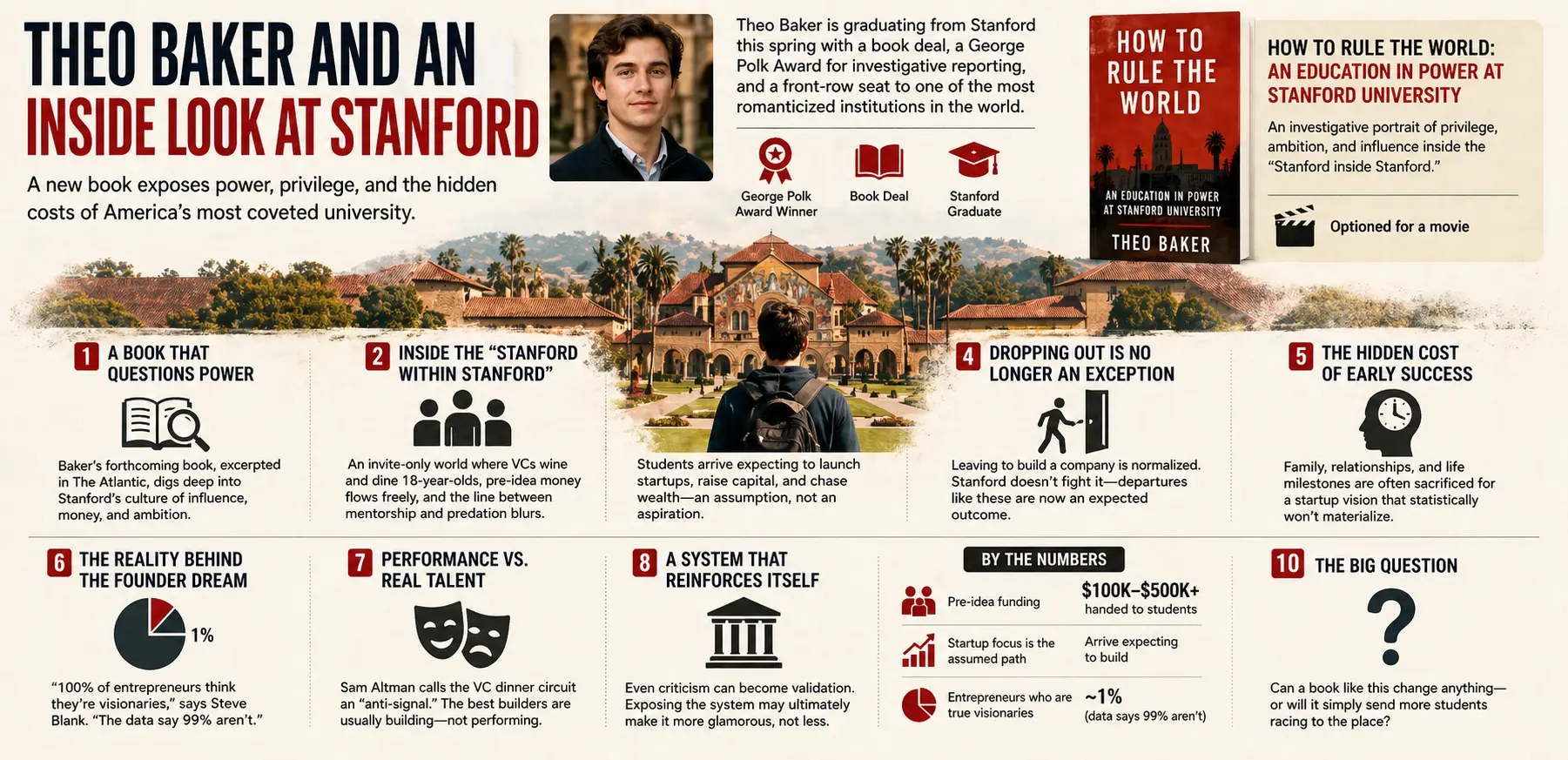
Theo Baker is leaving Stanford with more than a degree—he has a book deal, a George Polk Award for investigative journalism, and firsthand insight into one of the most mythologized universities in the world.
For more articles
A Book That Questions Power
His upcoming book How to Rule the World: An Education in Power at Stanford University, recently excerpted in The Atlantic, explores the inner workings of Stanford’s elite ecosystem. The central question it raises is whether exposing this system can truly change it—or simply make it more attractive.
When Critique Becomes Glamour
There’s a familiar pattern where criticism ends up fueling fascination. Much like The Social Network, which highlighted Silicon Valley’s darker traits but ultimately inspired ambition, Baker’s work risks becoming a magnet rather than a warning.
Inside the “Stanford Within Stanford”
Baker describes an exclusive subculture that students either enter early or miss entirely. It’s a network where venture capitalists court teenagers, early funding flows before ideas exist, and the line between mentorship and exploitation often blurs.
Startup Culture as the Default Path
What has changed is not the pressure itself, but how deeply it’s internalized. Many students now arrive at Stanford already expecting to found startups, raise capital, and pursue wealth as a baseline goal.
Dropping Out Is No Longer an Exception
Leaving college to build a company has become normalized. Stanford, rather than resisting, often supports these decisions, treating them as a natural extension of its ecosystem.
The Hidden Cost of Early Success
While some young founders achieve financial and professional milestones quickly, the trade-offs are significant. Personal relationships, time with family, and formative life experiences are often sacrificed in pursuit of growth and scale.
The Reality Behind the Founder Dream
The system runs on optimism, but the odds are stark. Nearly all entrepreneurs see themselves as visionaries, yet only a tiny fraction succeed at that level—leaving unanswered questions about the long-term outcomes for the majority.
Performance vs Real Talent
Sam Altman highlights a growing disconnect: students who actively network and pitch themselves may not be the ones building meaningful products. The system increasingly rewards those who can perform ambition rather than those quietly creating.
A System That Reinforces Itself
Even a critical book like Baker’s may ultimately strengthen the institution it examines. If successful, it could serve as proof that Stanford not only produces founders but also influential thinkers—further enhancing its allure rather than diminishing it.
