
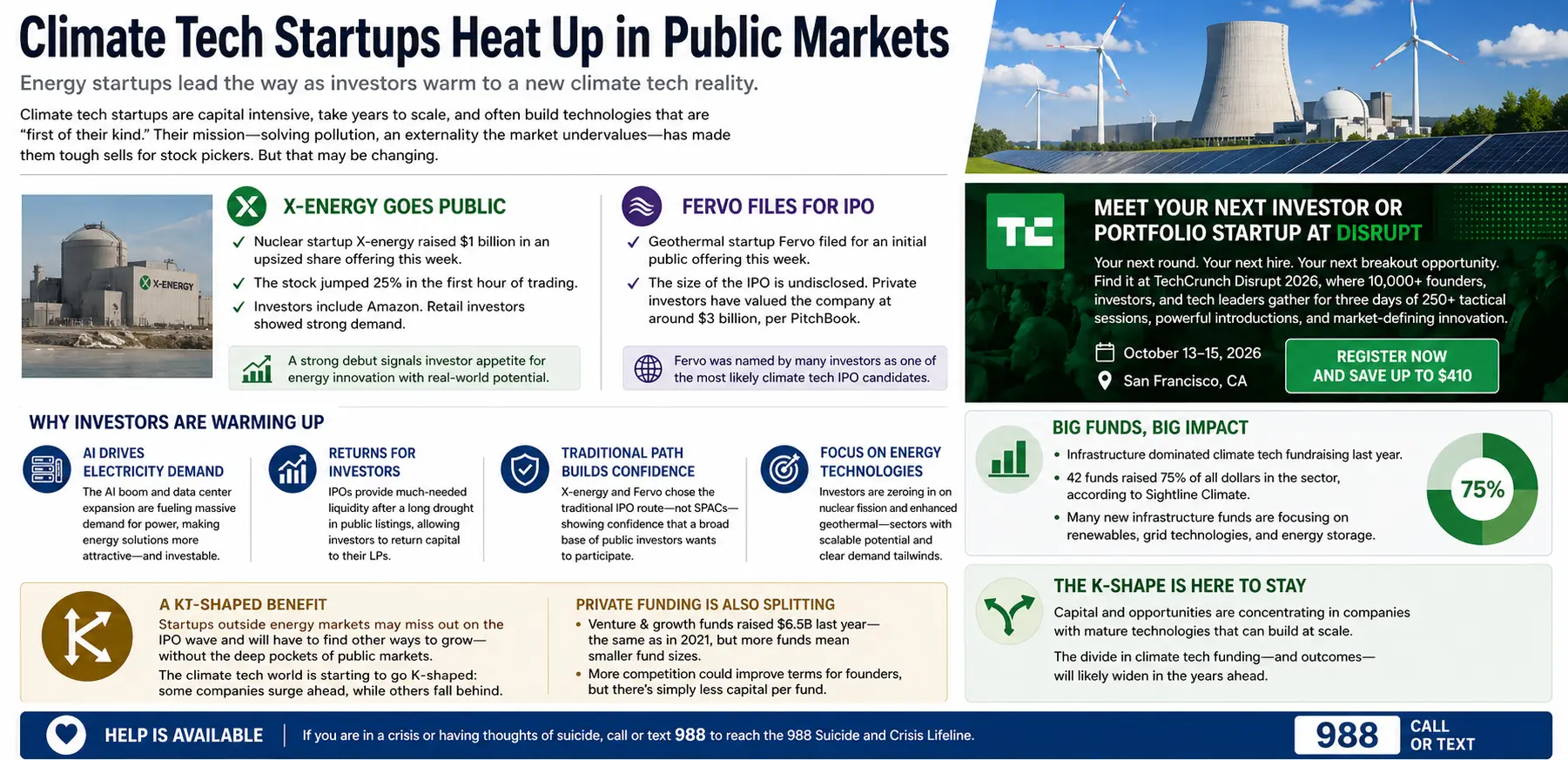
Climate tech startups typically require large amounts of capital, long development timelines, and often introduce entirely new technologies. On top of that, their core mission—reducing pollution—addresses a problem that markets don’t always price effectively. These factors have historically made them less attractive to public market investors.
For more articles
Public Markets Begin to Shift
Despite these challenges, sentiment appears to be changing. Some climate tech companies are now gaining traction in public markets, signaling a potential turning point for the sector.
X-energy and Fervo Lead the Way
Nuclear startup X-energy recently went public, raising $1 billion in an expanded offering and delivering strong early returns, with shares jumping 25% shortly after trading began. Around the same time, geothermal company Fervo announced plans for an IPO, with private valuations placing it near $3 billion.
Energy Startups Attract Investor Confidence
Investor expectations had already been shifting. Many predicted that energy-focused startups—especially those in nuclear fission and enhanced geothermal—would be the most likely to succeed in public listings. Both X-energy and Fervo fit that profile.
AI Boom Drives Electricity Demand
A major factor behind this momentum is the surge in electricity demand fueled by the rapid growth of AI and data centers. This trend has made energy innovation more appealing and aligned well with companies that were already developing solutions in the space.
IPOs Offer Liquidity for Investors
The recent wave of IPOs also provides an opportunity for investors to finally realize returns after a prolonged slowdown in public listings. This liquidity is particularly important for funds that have had capital tied up in long-term climate tech bets.
Traditional IPO Route Signals Confidence
Unlike some peers that chose SPAC mergers, companies like X-energy and Fervo opted for traditional IPOs. This suggests confidence in broader investor demand and a willingness to meet stricter public market expectations.
A Growing Divide in Climate Tech
However, not all climate tech companies will benefit equally. Startups outside the energy sector may struggle to access public markets, creating a widening gap within the industry—a “K-shaped” trajectory where some thrive while others lag behind.
Funding Pressures in Private Markets
Private funding is also evolving. Venture and growth funds raised about $6.5 billion last year, similar to 2021 levels. But with more funds in the market, individual fund sizes are shrinking, potentially limiting available capital for startups.
Bigger Funds Dominate the Sector
At the same time, large infrastructure-focused funds are expanding their influence. A small group of funds accounted for the majority of capital raised, particularly in areas like renewable energy, grid technology, and energy storage.
The K-Shaped Future of Climate Tech
This uneven distribution of capital suggests that the divide within climate tech will persist. Companies with mature, scalable technologies—especially in energy—are positioned to grow, while others may face increasing challenges in securing funding and scaling their solutions.
