
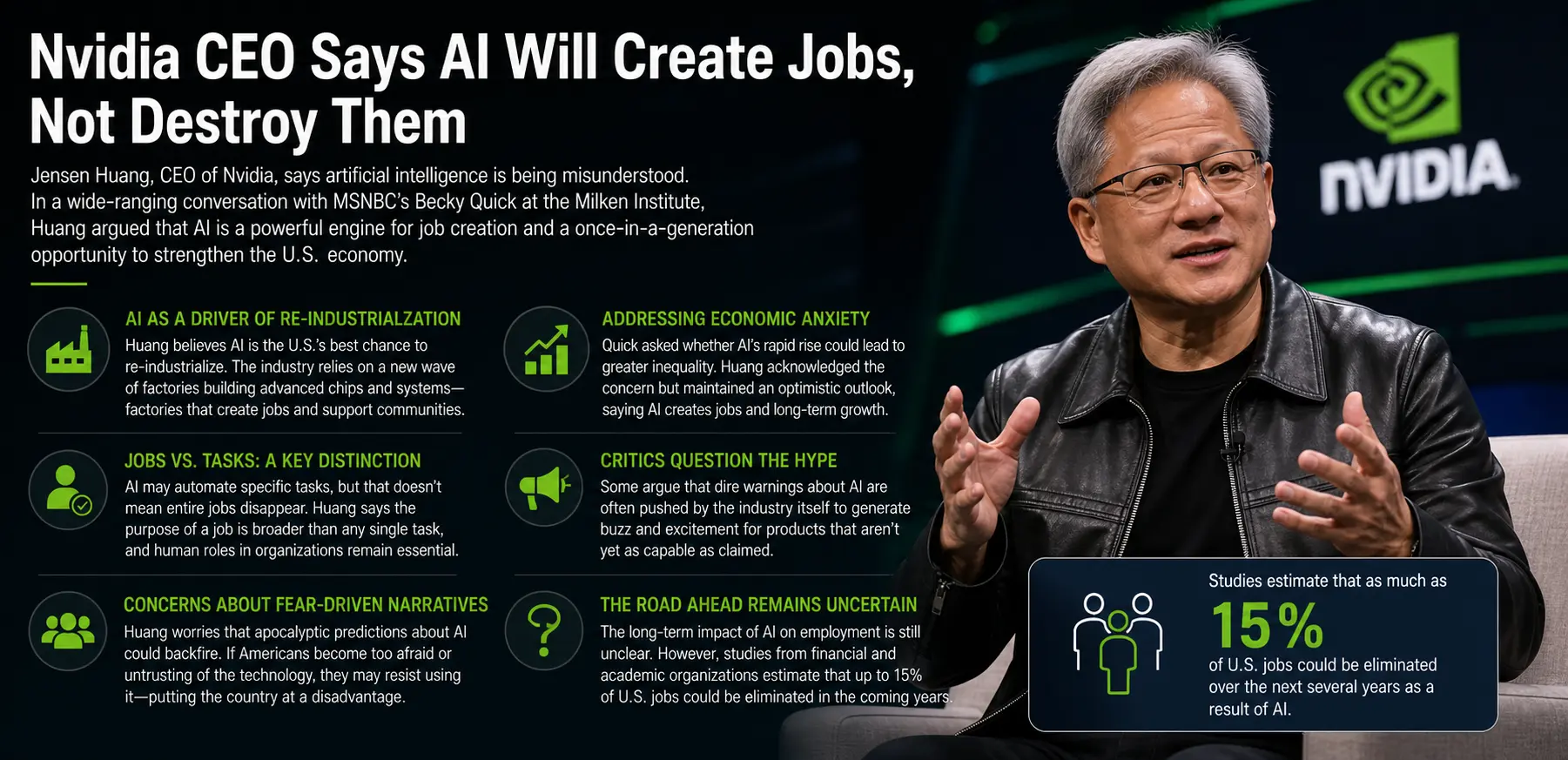
Jensen Huang, CEO of Nvidia, believes fears about AI replacing human workers are overblown. Speaking Monday evening with MSNBC’s Becky Quick at a Milken Institute event, Huang described artificial intelligence as a powerful engine for job creation rather than a threat to employment. He pushed back against widespread concerns that AI could trigger large-scale job losses.
For more articles
Addressing Economic Anxiety Around AI
The discussion frequently returned to concerns about how rapidly AI is evolving and whether it could increase inequality. Quick raised the issue of whether this technological shift could cause more disruption than previous industrial changes. Huang responded with optimism, emphasizing that AI represents a major opportunity for economic growth in the United States.
AI as a Driver of Re-Industrialization
Huang argued that AI could help revive American industry. He pointed to the rise of advanced manufacturing facilities that produce the hardware needed to power AI systems. These operations, along with the broader AI ecosystem, require a significant workforce, which in turn generates employment opportunities.
Jobs vs. Tasks: A Key Distinction
A central part of Huang’s argument is that automating individual tasks does not equate to eliminating entire jobs. He explained that while AI may handle specific functions, the overall role of a worker within an organization often remains intact. According to him, critics who assume total job replacement fail to recognize this distinction.
Concerns About Fear-Driven Narratives
Huang also warned against exaggerated fears about AI taking over society or devastating the economy. He expressed concern that such narratives could discourage people from engaging with the technology altogether, potentially slowing innovation and adoption in the U.S.
Critics Question Industry Messaging
Despite Huang’s optimism, some critics argue that dramatic warnings about AI have been amplified by the tech industry itself. They suggest that such messaging may serve as a marketing strategy to build hype around technologies that have yet to meet those lofty expectations.
Uncertain Long-Term Impact on Employment
While the future remains unclear, some respected economic and academic studies estimate that up to 15% of U.S. jobs could disappear in the coming years due to AI. Whether the technology ultimately creates more jobs than it eliminates is still an open question.
