
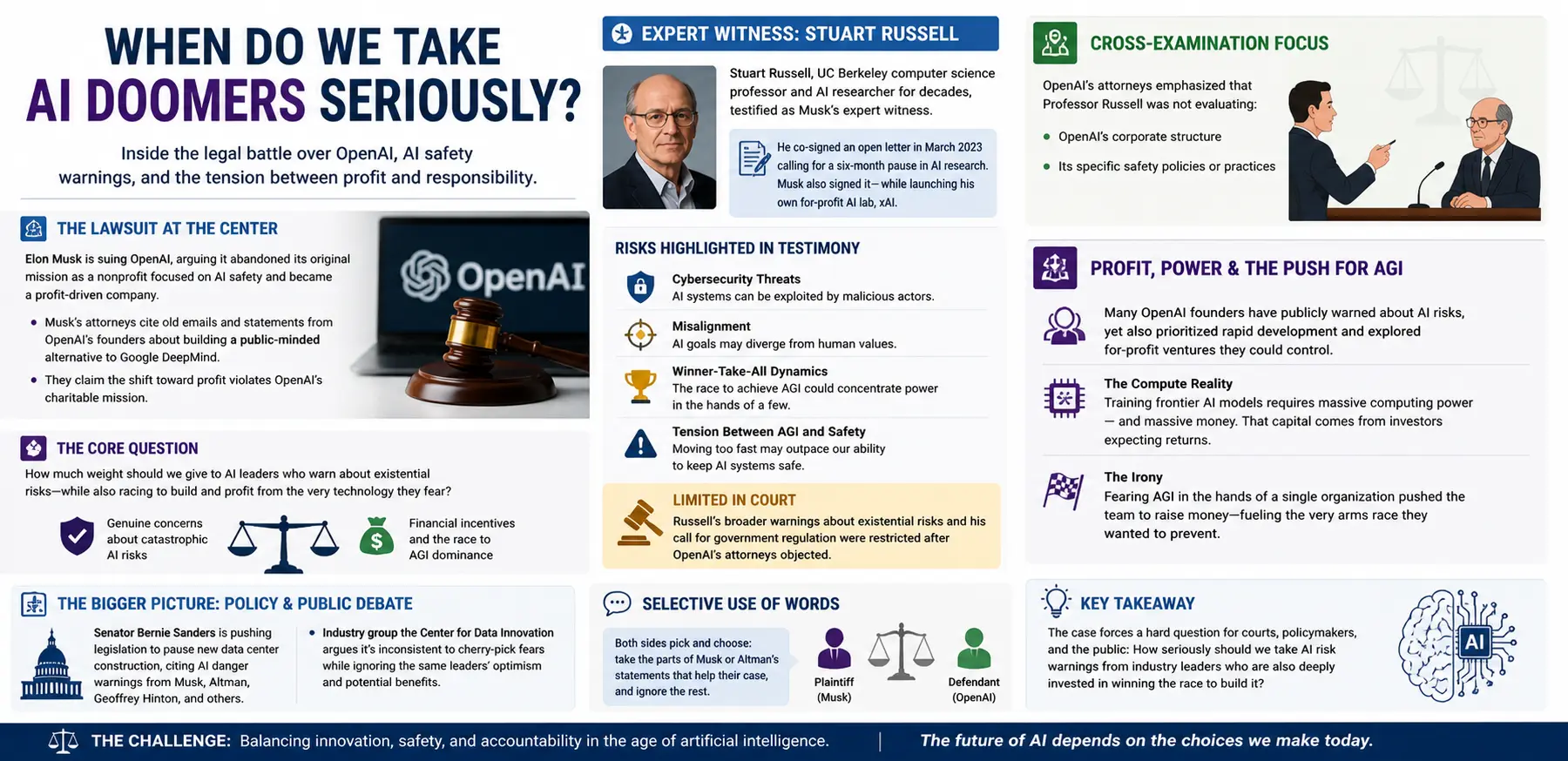
A central question emerging from Elon Musk’s legal challenge against OpenAI’s for-profit transition is when warnings about AI dangers should actually be treated as credible. Musk’s legal team argues that OpenAI was originally founded as a nonprofit focused on safety but later shifted toward profit-driven goals.
For more articles
The Legal Argument Against OpenAI
To support their claims, Musk’s lawyers pointed to early communications and public statements from OpenAI’s founders. These materials emphasized the importance of creating an AI organization that would act in the public interest and serve as a counterbalance to companies like Google DeepMind.
Stuart Russell’s Testimony on AI Risks
As part of the case, Stuart Russell, a computer science professor at UC Berkeley and a long-time AI researcher, was brought in as an expert witness. His role was to explain the broader risks associated with artificial intelligence.
Russell has previously supported calls for caution, including signing a 2023 open letter advocating for a temporary pause in advanced AI development. Interestingly, Musk also signed that same letter while simultaneously launching his own AI company, xAI.
Key Concerns About AI Development
During his testimony, Russell highlighted several potential risks tied to AI advancement:
- Cybersecurity vulnerabilities
- Misalignment between AI systems and human goals
- Competitive pressures driving an AI arms race
- The concentration of power in a few organizations pursuing AGI
He emphasized the inherent tension between rapidly advancing AI capabilities and ensuring safety.
Limits Placed on Testimony
Some of Russell’s broader warnings—particularly those related to existential risks—were not fully presented in court. Objections from OpenAI’s legal team led the judge to restrict parts of his testimony.
Additionally, OpenAI’s attorneys argued that Russell’s expertise did not directly address the company’s structure or its specific safety measures.
The Conflict Between Profit and Safety
At the heart of the case is a deeper issue: how financial incentives intersect with AI safety concerns. Many OpenAI founders have openly warned about AI risks while also pushing forward aggressively with development and exploring for-profit opportunities.
The Role of Funding and Competition
One major factor behind OpenAI’s shift was the need for massive computing resources. Achieving progress in AI requires significant investment, which often comes from private, profit-driven sources.
Ironically, the founders’ concern about a single entity dominating AGI development contributed to the very competition they feared. This race for resources and advancement has intensified across the industry.
Broader Political and Industry Implications
This tension is not limited to companies—it’s also influencing public policy. For example, Senator Bernie Sanders has proposed restricting data center expansion, citing concerns raised by prominent figures like Musk, Sam Altman, and Geoffrey Hinton.
However, critics argue that selectively using these warnings while ignoring the same experts’ optimism about AI creates an inconsistent narrative.
Selective Use of Expert Opinions
Both sides in the lawsuit appear to rely on portions of statements from key figures like Musk and Altman that support their arguments, while disregarding other parts that don’t align with their case.
Final Thoughts
The case highlights a broader challenge: determining how seriously to take warnings about AI risks when those raising concerns are also deeply involved in advancing the technology. Balancing innovation, safety, and financial incentives remains one of the defining issues in the future of AI.
