
Introduction
Dictation tools have become essential for quickly replying to messages and emails, whether on a phone or a computer. Apps like Wispr Flow, Willow, and Typeless already offer convenient voice-to-text features, but they rely heavily on your phone’s microphone or earbuds — which don’t always capture speech accurately. SpeakOn, a dedicated dictation device backed by Notta, aims to solve that problem with its own hardware. While the idea is compelling, the execution still has some gaps.
For more articles
What is SpeakOn?
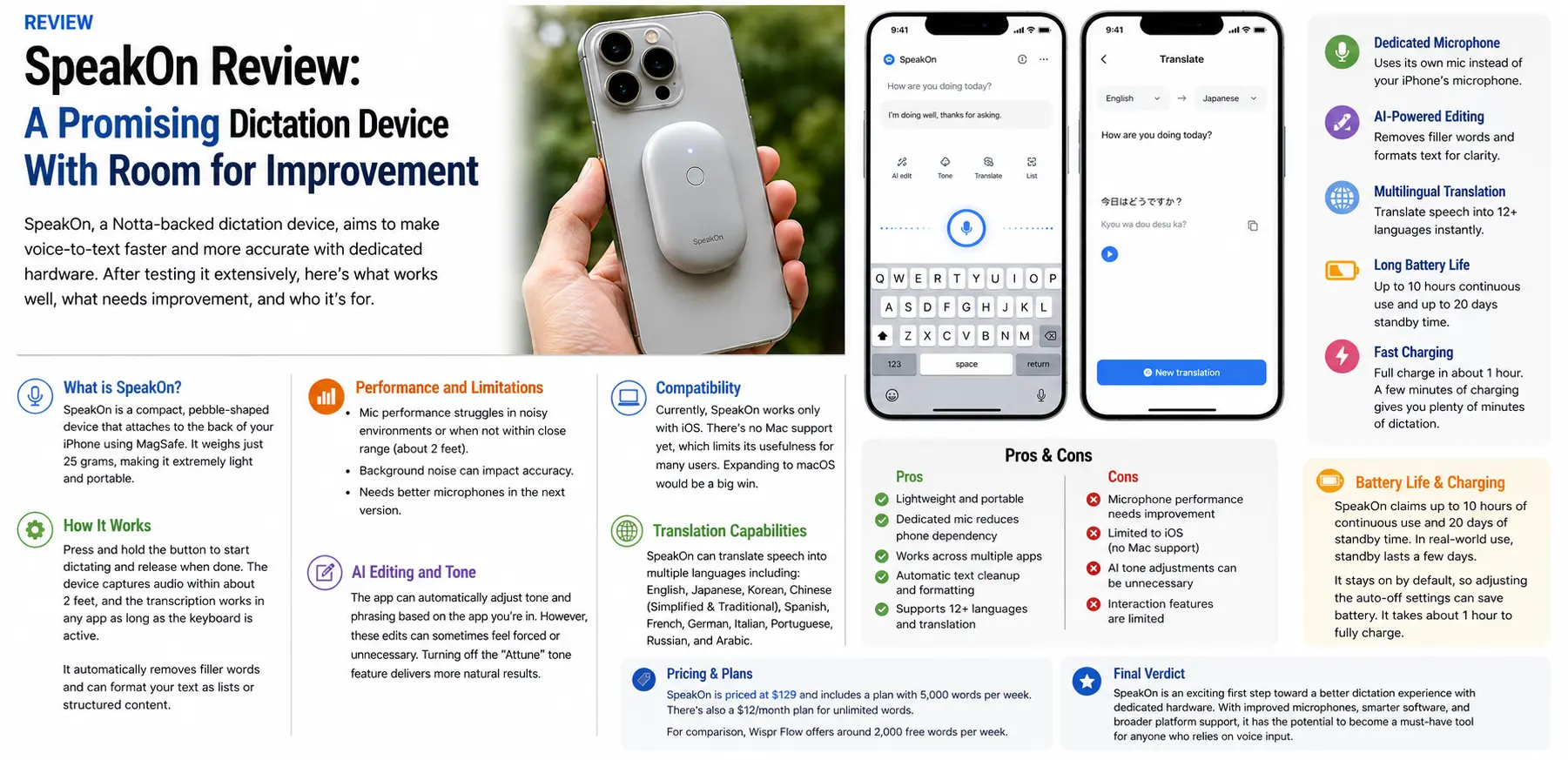
SpeakOn is a compact, pebble-shaped dictation device designed to attach to the back of an iPhone using MagSafe. Weighing just 25 grams, it’s lightweight enough to carry around effortlessly. The device pairs with a companion iOS app that works like a keyboard, allowing users to dictate text across different apps.
How SpeakOn Works
Using SpeakOn is straightforward. You press and hold the button to start dictation and release it when you’re done. The device features a built-in microphone that claims to capture audio within a two-foot range. As long as the keyboard is active, you can dictate in virtually any app.
The software automatically refines your speech by removing filler words and can even format text into structured lists. One notable advantage is that SpeakOn uses its own microphone instead of relying on your iPhone’s mic, helping conserve phone resources during dictation sessions.
Key Features of SpeakOn Dictation Device
- MagSafe-compatible design for easy attachment
- Lightweight and portable (25 grams)
- Works across apps via keyboard integration
- Built-in microphone for independent audio capture
- Automatic text cleanup and formatting
- Multi-language translation support
Performance and Limitations
Despite having a dedicated microphone, SpeakOn struggles with audio clarity unless it is very close to the user. Background noise further affects its performance, making it less reliable in busy environments. Improved microphone quality would significantly enhance usability.
Another limitation is the user interaction. Features like quickly activating the keyboard or starting dictation without switching inputs are missing, largely due to system-level restrictions.
AI Editing and Tone Adjustments
SpeakOn includes a feature that automatically adjusts tone and phrasing depending on the app being used. However, this can sometimes feel excessive. Simple sentences may be rewritten in a more formal or altered way that doesn’t match the user’s intent. Disabling this feature often results in more accurate transcription.
Compatibility and Platform Support
Currently, SpeakOn is limited to iOS devices, which restricts its usefulness for users who also work on Mac or other platforms. Expanding compatibility would make it far more versatile and appealing.
Translation Capabilities
Beyond dictation, SpeakOn can translate speech into multiple languages, including:
English, Japanese, Korean, Chinese (Simplified and Traditional), Spanish, French, German, Italian, Portuguese, Russian, and Arabic.
This makes it a useful tool for multilingual communication.
Battery Life and Charging
SpeakOn claims up to 10 hours of continuous usage and 20 days of standby time. In real-world use, standby performance tends to be shorter. Since the device stays on by default, adjusting power settings can help extend battery life. Charging is quick, taking about an hour for a full charge.
Pricing and Subscription Plans
The device is priced at $129 and includes a plan with 5,000 words per week. For heavier users, there’s a $12 per month subscription that offers unlimited dictation. Compared to competitors like Wispr Flow, which offers around 2,000 free words weekly, SpeakOn provides a higher base limit.
Pros and Cons
Pros:
- Lightweight and easy to carry
- Dedicated microphone reduces phone dependency
- Works across multiple apps
- Supports multiple languages and translation
Cons:
- Microphone performance needs improvement
- Limited to iOS (no Mac support)
- AI tone adjustments can feel unnecessary
- Interaction features are somewhat restricted
Final Verdict
SpeakOn introduces an interesting approach to dictation with its dedicated hardware and MagSafe integration. While it benefits from being an early entrant in this space, it still needs improvements in microphone quality, software refinement, and platform support. With the right upgrades, it could become a valuable tool for users who rely heavily on voice input.
